Sunday, 26 April 2015

First Rehersal: Notes and Analysis

Disclaimer: I was absent for the first lesson; I have read and with permission used Holly Garcia's to write my own.

Prologue creation:

We started off by creating the absolute top of the show. This section is not scripted however it's purpose to establish the concept of teenagers breaking into this Victorian building. We have made use of the many entrances by designating different groups enter from them. The first group will enter from the main entrances slowly, discovering, looking around the space in wonder. This eases the audience into the world of the play giving them a false sense of security. My group is stationed by the fire exit door. We are the "pinball" group as when we enter the space we immediately start pinging around the space running full of excitement. This keeps the energy up and makes the space come to life and the audience interested in the action. We must really go for it and truthfully interact with each otherwise it will not work. We then gather in a circle around Clay who has his prop axe, he then smacks it into a box and on the line "Mah" we exit the main space as birds. We did some research on different types of birds in order to create authentic movements:

I chose a bald eagle, here are a few facts I found -

Length: Around 3 feet; males are smaller.
Wingspan: Females around 7 feet; males around 6 feet.
Weight: 10-14 lbs.
Lifespan: 20-30 years.

Scene 1:
This is the shipwreck scene where we are introduced to Daphne. The main action is to take place on the balcony because there will be no dead space and we can have a continuous stream of work; they'll no need for a blackout or a transition that might kill the energy on stage. We then, from separate sides of the audience, silently act like we are on the boat on the balcony whilst the lines are being spoken. On the cue line "Die Die Die" we begin to swirl round the space until we are near the centre then we collapse on the floor. To make this effective I must use my entire body to create the swirling motion and not just my arms. I believe this could be really poignant if we leave a beat  for the audience to fully take in what they have just witnessed. 

Scene 2:
This is a direct continuation of the previous scene so there is no break thus no time for the audience to get bored. We start to drum rhythmically while singing the "Imo song". As the drumming continues we "re-animate" contorting our bodies back into shape making it clear that we are no longer human. This looks most effective when we give it 100% using out eyes and heads to snap our body parts back into position. Mau then rips off our masks and we scream die and crawl off. We can't just exit the space normally; we must contort our bodies and creepily slide out bodies off to not break the illusion to the audience. We then shake uncontrollably at the sides to try intimidate the audience and create an atmosphere of discord and fear. 


Mau costume ideas

With Mau I could go down several roots, In the original script he is a native island boy so he would not have access to "proper clothing". From the production at the National Theatre this is what the designer envisioned for Mau:

However I don't believe that this is suitable for our version of Nation as it doesn't fit within the concept we are going for (found objects). We could edit Mau's original costume; for example instead of sack material loincloth we could use adidas shorts and roll them up. Instead of being shirtless as this may make the audience members uncomfortable in such an intimate space so we could go down the route of going with a ripped
t-shirt to show Mau's disconnection to the "civilised" colonist world. This means that the costume could be easily altered for later scenes where we see changes to his clothing. When Mau returns wearing "Trouserman" clothes. We can show this change by adding an overcoat and khaki trousers. This will register with the audience quite easily.

Another route we can go down which will match the conceit of the performance is "urban clothing" edited. What I mean by this is wearing items like tracksuit bottoms and jeans but altering them to look my "native" as the play progresses. So I would roll up my tracksuit bottom, someone could rip holes in their jeans, tear their shirt, take off ties and tie them round their heads. I believe this would demonstrate the island themes to the audience.  


Examples of script annotation and objectives


Before even beginning work on my scene I have gone through the entire script and annotated my lines with breath marks, physical objectives and possible movement/vocal ideas. I have marked out my breath patterns on each line for several reasons; 1) To figure out whether I need to take long or short breaths on a line so I don't run out of air and make the line lose  effectiveness. 2) To figure out Mau's thought changes so I can really work through his emotional transitions and create a three-dimensional character. Through this I have realised Mau is quite an emotional erratic person and goes through many thought changes in a single line. I now know I need to reflect this in the way I portray him to the audience. This gives me ideas about his status and how he reacts to other characters. 

I have identified a section where Mau goes from being moderately happy to absolutely enraged; This could end up being quite a sticky transition because if I just snap straight from happiness to anger the audience could perceive this as fake and bad acting. I must make sure I show the build up in tension between Mau and Daphne and then hit the peak on the line "TELL THEM" otherwise it won't make sense. This exercise has helped me to understand the text in more depth. 

Group work - Polynesian dance research

Polynesian Traditions


Dance
Since 1998, Heiva contests allow to conciliate these two elements promoting both creativity and respect of tradition

Four type of dances are presented during the Heiva contest :

  • the ote’a,
  • the aparima,
  • the hivinau
  • thepa’o’a.


Abolished in 1820 by the British puritan missionaries


The ote’a


The main Tahitian traditional dances. Originally it was reserved to men only but today it is also danced by women and is characterized by wide and abrupt moves and a quick and jerky rhythm. Moreover, the huge number of dancers and their geometric disposition on the scene allow group movements that are really impressive for spectators, but does not leave much room for creation.
.


The aparima


The dance of gestures par excellence : hands describe a story thanks to a large scale of symbolic gestures (the sea, birds flight, voice…). Slow dance


The hivinau

The easiest and technically the less demanding of the Tahitian dances although not the less visually impressive. Actually, dancers stand on two concentric circles -commonly a circle of women and the other of men- and turn round in two opposite directions. These crossings allow to illustrate great daily life and sea life scenes.


Possible ideas to create these dances:
Hula hoops as props to get the hip action. The concept of our play is found objects so this prop will work within the world we are attempting to create. If we wish to make a tribal dance we could mimic the moves of one of these dances but add in hula hoops to draw a comparison with the 21st century. We could get all different colours and sizes and use them to even travel through the space!

We could mashup modern/contemporary dance techniques with some of these traditional dances. We could use the hand gestures and movements from dances like "The aparima" whilst mixing them with more recent dance moves. For example we could have all the traditional dance movements in the arms while the legs are "cutting shapes" which is a more modern dance craze.

Finally we could learn one of these dances as a company and put it into the piece. We could use a file grabber and use the sound file and try out best to simulate the movements. We could also assimilate it into a simpler physical theatre movements and gestures.

Tuesday, 21 April 2015

Nation Trailer


What have I learnt from the original adaptation?
The original production of Nation at the National Theatre had a massive budget, expansives sets and intricate costumes. We have not been afforded such luxuries, so this means we have to find other ways to create this enormous world that isn't dependant on money. Luckily the core concept of the piece allows us to play around with the idea of using costumes and props we've sourced for quite cheap of even free. For instance objects like guns could be replaced with toy bb guns and it won't take the audience out of the world or create unwanted comedy. I can also see from the trailer alone that instead of creating a colourful world on stage they have decided to take a darker approach e.g. using dark tonnes and hues and emphasising the darker elements within in the play. For our adaptation we have taken the opposite approach by encouraging characters to wear colourful clothing, making a multicoloured puppet bird and focusing on the fun and comedic moments of the play.    

Song lyrics for sea shanty transitions

In South Australia I was born, heave away, haul away
In South Australia, 'round Cape Horn, were bound for South Australia

Haul away your rolling king, heave away, haul away
Haul away, youll hear me sing, were bound for South Australia

As I walked out one morning fair, heave away, haul away
'Twas there I met Miss Nancy Blair, were bound for South Australia

There's just one thing that's on my mind, heave away, haul away
That's leaving Nancy Blair behind, were bound for South Australia

And as we wallop round Cape Horn, heave away, haul away
You'll wish to God you've never been born, were bound for South Australia

In South Australia I was born, heave away, haul away
In South Australia, 'round Cape Horn, were bound for South Australia

Sunday, 19 April 2015

The Space


Devising ideas for scene

In this lesson we were given the task of getting into groups and devising a particular scene. My group were given scene 9 or "the birthing scene". This takes place in the woman's place which is supposed to be a hut on the island. As theatre makers this posed a challenge for my group as if we chose to set it purely in a tent it would block the action off and the audience would lose focus. This is what we decided to pitch to the class;

Props needed:


  • Bamboo sticks (normal sticks will do) 
  • Umbrellas 
  • Brooms 
  • Mops 
  • Curtain rods 
  • Tubes 
  • Any other long stick-like objects 
  • Blanket
  • Toy baby 
  • Medical book 
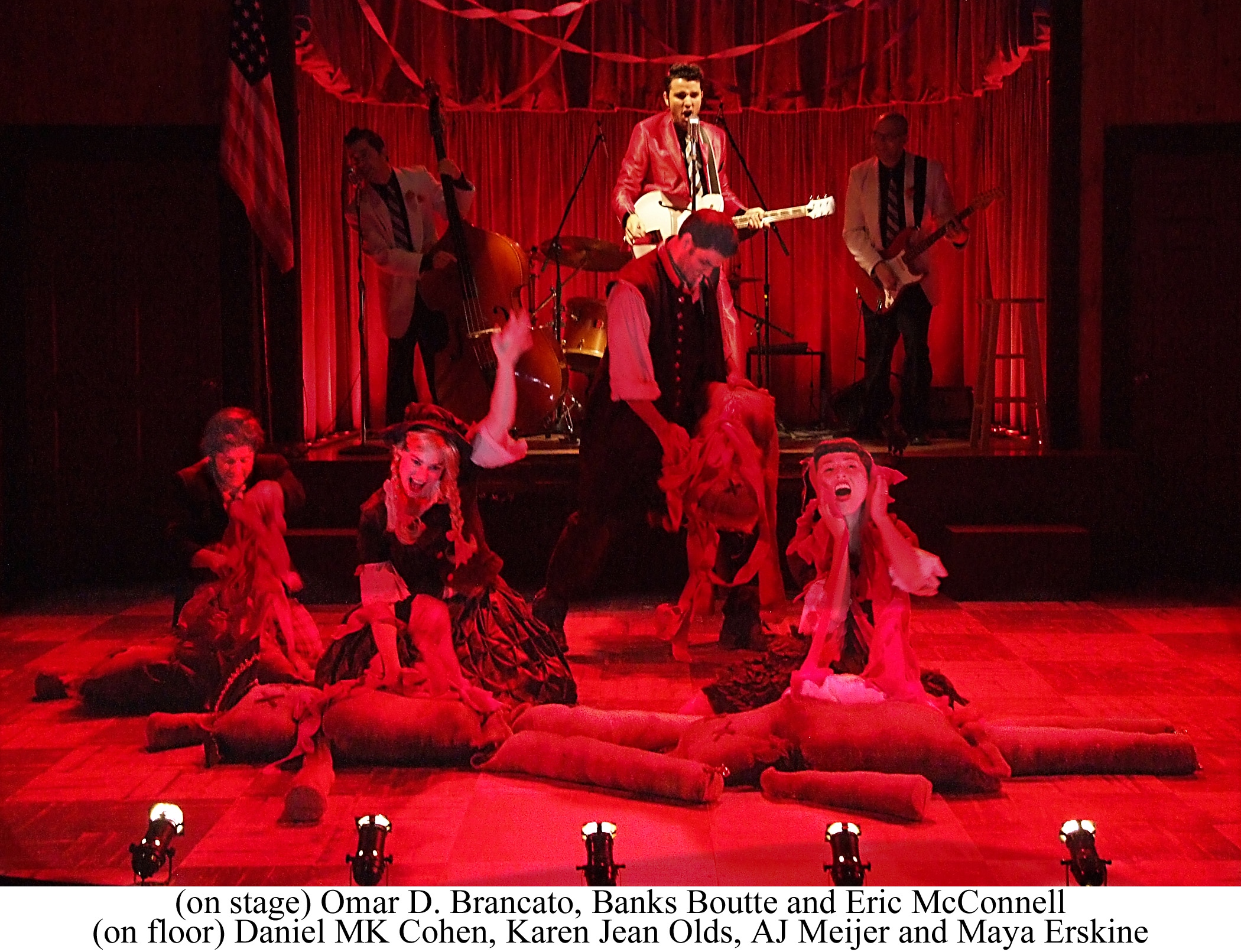
We would have strong red lighting to create an atmosphere of tension and suspense. We would then use a complicite (theatre company) exercise to create a transition: You place a bamboo stick/stick-like object between your index finger and your partners finger. You then travel around the space whilst maintaining eye contact finding interesting ways to move, going up and down, faster and slower. This would create a complex and interesting ritual dance if we pair it with some music in the background. As the ensemble travel round the space I would have Daphne lead Cahle to centre stage and as soon as they hit their mark the ensemble create a tipi around them using the sticks and a blanket is thrown over the top to make it into a tent, completely blocking theme from the audience. We've done this purposefully to create comedy, if the audience can just hear Daphne's lines then their minds will do the rest.

After Daphne's mini-monologue she throws the book out of the tent, this would then be the cue for the stick bearers to disperse and move behind the audience where they would lean their sticks over the seats to create the illusion like the audience are now inside the tent. This in turn solves the problem of visibility and will make the audience feel like they are now apart of the action. We also thought that the men should go up to the balcony to show how they cannot enter the women's place but we can still see their reactions to what's going on.

For the naming song section we were hoping we could have a blackout and then project stars onto the ceiling of Stanley Halls and have the entire ensemble singing twinkle twinkle little star in a round whilst moving around the space as Daphne watches in amazement. This could look really effective as in the darkness the voices will really stand out.


Character Research

In this production I have been cast as "Mau". In my opinion he is a very complex character who is going to be quite a challenge to play however I am looking forward to playing him for the middle section of the play. He has scenes in the dream world, underwater, in the cave of grandfather's to a name a few. When it transitions into my time as Mau he goes through a change from being just a half boy/ half man who isn't quite sure of himself into a strong confident chief of this new titular Nation. In order to Accurately portray this character I need to go through the text and analysis key information about him and then do some of my own research on the word he lives in:

What do people say about Mau?

  • "You have no soul (...) you are between boy-soul and man-soul" - This shows that Mau is not mature yet but he is not a child. He is (in western culture) considered to be adolescent. This is good because he is of the same age as me making him easier to relate to however he has grown up in another societal system where masculinity and coming of age ceremonies exists. In my performance I must portray the importance on masculinity and power in my leadership and attitudes to other males in the Nation.  
  • "Some of them laugh at (...) your trouser man clothes" - We see that Mau is now wearing traditionally western clothes like trousers. This means that he is trying to state his superiority over others through the way he dresses albeit subconsciously. This shows that within the Nation there is some doubt and insubordination, This motivates Mau to try and prove himself and assuage people's fear in his leadership qualities. 
  •  "You're a great Chief" Mau is capable of making good decisions that (even if he doesn't believe in himself) will bring happiness to his people. This means that throughout the piece I must show the evolution of Mau and portray his growth in confidence as a leader and a man.
 What does Mau say about himself?
  • "I'm not ready, I can't carry the burden" He is referring to Pilu volunteering him to be chief. (This is from a section of text where I am not playing Mau however in order to give 3 dimensional performance I must know what thought processes my character has previously had and carry them with me). Mau is reluctant to become and is worried about having such responsibility. This means I must show his insecurities and hesitations when it comes to making decisions. 
  • "I'm Chief. I should watch out for raiders" Mau has now acknowledged his responsibility as Chief and is now actively doing duties. In my performance I must now show the audience that there has been a change in Mau's mentality. It also states in the stage directions; " He now wears Robert's hat and trousers". This shows that he is assimilating the advancements that Daphne has brought with her". I believe now has a slight superiority complex and I must demonstrate this in the way he treats the other Islanders" 
  • "I am strong, The strongest." Mau is defending himself and his own identity. As an actor I need to make a judgement on whether I want to play this line seriously or unsure. At this point in the play I don't believe me is that self assured and is just saying this line to protect his own ego so I shall play slightly unsure but deliver it with strength. 
  • "I am sorry for the angry words I shared with him. I respect and love him as if he were my father. I will take revenge" This is my final line playing Mau so I need to deliver it with passion and emotional depth, Mau has now grown and can recognise his own mistakes. I must show this self-realisation to the audience in the way I phrase the line e.g. putting emphasis on the words "Love" and "Respect". 
Five stages of grief 

On a character analysis I found here: http://www.shmoop.com/nation-pratchett/mau.html, It suggests Mau could be going through the five stages of grief because of the loss of his people. So I did some research on this;


1. Denial: When he returns from the boy island and discovers everyones dead. 
2. Anger: Mau's anger at the God's, Daphne and Ataba.
3. Bargaining: Saving others lives to make up for the loss of his own peoples.

4. Depression: Before Daphne arrives and is isolated. 
5. Acceptance: End of play, Mau becomes a competent chief and leads a new nation.

In conclusion I must use this depth research to shape and characterise Mau as an unsure adolescent and demonstrate his coming of age. I must also successfully show the audience how he copes with the death of his people and how this changes him.