Monday, 4 May 2015

Final Evaluation

Throughout this unit I have had to use many different performance skills, especially in our final performance, however before even stepping foot on stage some of the most important work I did was on the text. Breaking down the script and analysing each line gave me insight into the complexities of the role I was trying to fulfill. I found once I marked out my breath marks finding the character voice of Mau was much easier as I now could tell his breathing patterns and how the writer wishes to create emphasis on particular lines. Knowing my objective was seminal to creating interesting scenes onstage. If I knew what Mau was trying to communicate with each line it become way more straightforward to portray his thought processes and emotional transitions. It also gave me the ability to up the stakes of the scene; The most interesting theatre comes when a character is desperate for something so by knowing what I truly wanted on every line I could fight for it. Also knowing my objective helped to shape my vocal work. I could no figure out what inflection to use at the end of lines and what modulation was required to have the greatest effect on my scene partner moreover creating more depth in my relationship with the other characters. Likewise during ensemble sections of the play the best work was created when we as a collective shared the same objective.

Another performance skill I demonstrated well was my adaptability. As we chose to seat the audience in the theatrical configuration I had to concentrate on where I focused my energy throughout the piece. I used thought back to the final unit of Year 10 and I remembered the workshop we did on working on three sides. So throughout the performance If I felt like I was directing too many lines to the left side of the audience I would turn to the other side, I would put myself in positions so that both seating banks could see me but most of all I tried my best to keep my chest facing one way but my head and face another. This made sure that both sides of the audience were getting some of my performance whether that be physically or vocally. In addition to adaptability using my instincts as an actor was critical in creating effective theatre. Experimentation and imagination where two big factors that were emphasised during this project; in order to do those things I had to rely a lot on my actors instincts. When my scene partner gave me something new or decide to change their intension on a line I could easily find a way for my character respond within in the confines of the scene. Sometimes I would get it wrong though but that was okay. If I went for a character choice wholeheartedly but it didn't work it was alright because it was all a part of discovering what works within the performance.

Research was a fundamental part of creating and sustaining a 3 dimensional role. Without research I wouldn't have been able to dive into the role and analyse the character that Terry Pratchett presented me with. I discovered off my own back that Mau transitions through the 5 stages of grief throughout the piece; it doesn't say so in the text but it is quite an important factor in creating the psychological mind state of Mau. This research also helped me to find the truth within my representation. I didn't want to feel like I was just going through the motions so I made sure to surround myself with the world that Mau inhabits so I could always found new stuff to bring to my performance each time. It also helped me to unearth the historical context of the play. I find this very interesting not just from an acting perspective but from a living human being perspective. It's awesome exploring different time periods and learning about different cultures. I believe this develops the way I look at the world moreover opening up my eyes to new acting possibilities and deeper outlooks on the way I execute my roles. Finally research allowed me to find new subtle nuances within the conceit of this production. Research into tribal movement and dance made it easier for me to improvise elements of the piece. When ask to become the ocean I could utilize the videos I watched when first began to research into the play.

Costume was another way we made this play so alluring. When using multiple actors in order to keep the connection and show the audience that is the same character we used significant pieces of clothing or prop to show this. The three Mau's all shared the same crab necklace; the five daphne's shared orange ribbon; all the Locacha's dressed in black. Also we try to co-ordinate another piece of Mau costuming by wearing an extra shirt over our tribal clothes to symbolize our slight lean towards civilisation, We chose to use Hawaiian shirts to represent the island heritage and I thought it would also read quite well with the audience. Not only did we use costume to represent the "native" characters of the play but also vintage clothing to give the audience a taste of victoriana. It really worked how all the bright colours created a fun and magical atmosphere. This paired excellently with the powder paint we use in the final run. I hypothesize that this is a reason why our adaptation was slightly more captivating than the original production at the National Theatre. On the other hand I feel as if we could have refined our costumes even more to fit the concept of out performance. Shirts could have been ripped, everyone should have been bare-foot, beads, necklaces more traditionally tribal elements could have been hidden under our normal clothing.

Yet in my own performance I can find a lot that I could improve. After a while I could feel my vocal patterns were stuck in the same rhythm. Even if I was making different physically choices and using altered facial expressions I would still find myself using the same old intonation. Even though I did learn my lines cold I still found myself going back to the same pattern. I think this was because I found comfort in knowing what I was doing. In order to change this for the next project I am in I need to, (whenever I begin to fall into the trap) stop and force myself to change the way in which I am saying a line. I also desperately need to work on my singing, I am very self-conscious when it comes to being loud with my singing voice as I am most the time very out of tune and off key. Nevertheless for my performance I could have been louder and just acted through the song instead of shriveling up. Another way I could have fixed this was by getting singing lessons are asking one of my musically gifted friends to teach my song singing techniques. Finally in my performance I felt myself lose focus when playing a soldier with no lines. At one point I just noticed I was staring off into space instead of actively engaging in the scene. Even if I had no lines and my job was to just kneel for 5 minutes I still should have been offering interesting reactions. If an audience member happen to look at me at that particular moment it would have ruined the illusion for them,

Working as a 50 people strong ensemble presented us with quite a few challenges. It was quite difficult finding the balance between not blending into the background of the scene but not pulling focus. Sometimes I felt I wanted to react to something or have a physical reflex I would be distracting from the main action; On the other hand I also sometimes felt like I wasn't offering anything up and I was boring to watch on stage. It helped when we went in performance mode because people had more energy thus they wanted to give something on stage. I also recognised that you had to find the correct mix of Selfish vs. Selfless. There were moments on stage for instance when I was monologuing about the unimportance of my people when I wanted all the audience to only be focusing on me. This however was paramount in communicating the story and what I was saying was imperative information in the story so it was okay to be selfish. Nonetheless there are moments on stage where you must give your energy into making sure that another actor's performance is seen. You do this by giving your eye contact and unadulterated concentration on them. Your eyes are just miniature spotlights.

I have learnt many things about acting during this unit. Some of the most important are; being hot on your cues and physically cutting people off on cut off lines. If we didn't do this it would have killed the energy of the piece and made it a painful 2 hours to sit through. In order to work on such a colossal project I must have patience. If another actor is messing up their lines instead of getting angry and shouting at them I need to take a moment and help them learn their cues instead which will be more productive to the process. Even when you're exhausted you still have to give 100% . It's not fair on the other actors that just because you aren't feeling it today that it should impact on the entire room. It's okay to be grey! If you find yourself losing the zest in your performance it doesn't mean you are a bad actor it just means you haven't hit the technicolor. You just need to keeping trying to find new ways to make the peformance interesting for yourself. When inhabiting a big space you must use expansive movements and gestures as small performance do not read as well. Coming into the rehearsal room with multiple ready thought out ideas makes the directors job ten times easier as they can pick which options work best within the piece.

Performance night was when it all came together. I think at some point everyone consider the reality that the show just wasn't going to work however we managed to pull it off with aplomb. During the performance a lot of things went wrong but as an ensemble we always managed to fix them. My crab necklace broke as soon as I put it on and I didn't have time to fix it so during my highly active scene swimming through the space as soon as I got to a chair I held it up to the light like I was inspecting it and then hid it in my pocket. Behind stage I got someone who's good with knots to fix it for me before the next scene and boom! problem solved. I also identified that no matter how well you know the piece nerves will still affect you. Instead of saying "people live in fear fetch the canoe" I said "people live in fanoe". I have no idea why said that but because I didn't let on that I made a mistake I'm pretty sure the audience didn't notice. We worked for a full day with only one 45 minute lunch break so by the bow I think everyone was pretty fatigued. I discovered just how resilient and the level of endurance an actor must have. I didn't let this change my energy in my performance though, On the contrary I feel like the tiredness allowed me to unlock further emotional depth. During the dress run I was directed to adlib an entire scene because previously it hadn't been working. I felt it was very important to keep these improvised lines coming as if there was any dead space it would kill the scene. Finally I grasped how important it is to take care of your fellow actors. If they come in with the wrong line there is a collective responsibility to adjust the scene so the audience don't discover the error has been made.

In conclusion, This has been a long unit filled with exploration and challenges but it has definitely developed and shaped me as an actor and as an art maker. It has been quite a journey since the first unit of year 10 to the end bow of Nation but it has been one that was worthwhile. I am glad we chose such a difficult text and I look forward to using these skills on my next production!



Schematic of Stanley Halls and journey through space


Video Research


What have I learnt from Terry Pratchett and Mark Ravenhill's insights into Nation?
Terry Pratchett discovered the central image of Mau standing with a spear screaming at the gods whilst writing another book; he says he didn't even know the character's name or his story but his imagination revealed it to him as he began to work on the story. Imagination is absolutely seminal to our production and even if we don't know the end project right now we should at least have faith in out creative process to get us there in the end. He also speaks about how on stage you lose some of the nuances of the book however he also states that the stage will create some new ones. This means even if we don't communicate all of the books central themes in our adaptation we can discover new ones as we play around with the text and the space. 

Mark Ravenhill talks about the deeper messages of the play; for example themes of morality, existentialism, loss of faith and grief. On the surface Nation could just be a play about two kids who become friends on a tropical island but actually Nation has many many deeper meanings that we must communicate to the audience if we want this to be a successful project. He also talks about making it your own and going inside the characters and finding your own traits but still keep returning to the text. I believe it is very important to make strong character choices but I always must keep in mind the information the text has given me about Mau.   

Sunday, 3 May 2015

Rehearsal log - Scenes 10, 12, 13,14 and 15

Scene 10
This contains another ensemble section that involves the entire cast. When Mau says the line "Stop that right now old man, I have a plan" everyone shouts "No!" and we enter from behind the audience and begin chanting "Beer Beer Beer Beer". We will use stylistic tribal movements as we enter the space getting low. We then create two circles with men in the middle and women on the outer one. We have designated Tobi to count how many cycles we go through (8) until we move into the next section. The men then begin to embody the element of water and the women become fire. This stimulus helped us to create in depth movements instead of just saying wave your arms in a floppy formation. We then mime spitting into a bowl and move back to accommodate space for the women until we've swapped positions. We then transition into men embodying earth and women air. We then create one big circle whilst squatting and go into our individual group tribe rituals;

*This section of the lesson we focused on creating our own tribal rituals be working around a piece of text we were allocated.

"Never Return son, never return 
Travel and never come home
Father, I wandered, now I am old 
Travelled so far I am home."

My group decided to go with a repetitive shoulder and leg movement that sort of worships the earth to symbolize the travelling of the son. We use big hand gestures while Courtney and Tobi say the first 2 lines. We then encircle each other so that the three boys are standing behind me, we then go into a shoulder stand like the one demonstrated on the right:

If possible we would like to purchase some coloured powder or even flour so that when we are at the top of our performance we can blow it of our hands like flour to give an extra dimension to our performance.

After our individual sections we then squat in a circle in silence while Milo goes to test the beer at centre stage. The silence is really effective as after the big cacophony of sounds it ups the tension and lets the audience absorb what they have just witnessed. When Milo says: "The beer is ready" we let out an ululating cry of excitement then straight away go off to create the scenery for the  next scene. Some people create trees in twisted positions however I become a pig. I pair with Kit and we create this position with 4 other couples to simulate a giant sow with piglets. Kit and I are the head of the pig so we have to use our elbows to show the pig drinking the beer. On the line "That's it. Come on." we the transition from the pig to hungry islanders at the back of the stage and come forward on the line "Worms! Help!" I must make sure my starving islander character is just as strong my main character. When invited we then integrate into the space. We have yet to figure out a transition into the next scene but from here we exit the space.

*The next section is notes from our session working with the Year 12's and how they directed and devised a part of our play:

Scene 12
This is when I first start playing Mau thus my entrance must be strong and I must come in showing similar character traits to my fellow actor. The directors said I should enter from the balcony as if I've been watching over the previous scene and this also gives me a very high status. I must be very aware of my spacing and movement onto the balcony as I still need to be visible to the audience without falling over the stage. The year 12's told me I need to be less assured in my speech as I am coming across to confident i.e. on the line "then we must build stronger huts" I need to deliver it as if I'm just trying to coming with a solution to a problem instead of just a statement. At the end of the scene I exit through the cafe door to prepare for the next scene.

Scene 13
I enter with Pilu, Milo and Ataba and climb onto chairs or blocks that haven't been positioned in the centre of the stage. The directors told us that it was like we were playing a game of "the floor is lava" and my objective is to not fall off the chair or else I die. We keep switching chairs and reaching into the water until we've found the "God anchors". When it comes to the dialogue we have to keep it sharp and punchy in order to keep the tension of the scene high. After the line "old man" I have a slow motion fight with Ataba in the water then hoist him back up on to the chair. Moving onto the next bit was quite confusing as the sixth formers didn't know how to choreograph the shark however at some point I end up on a chair doing the backstroke while the 4 Locaha's encircle me. Then after I die they carry me off ready for the next scene.

Scene 14
For the entirety of this scene I am dead. This is easier said then done so I did some research and I found a good article on playing dead;

http://www.quora.com/Acting/How-do-you-play-dead

Scene 15
On the cue line "This will not happen" I wake up in this world of the dead and immediately grab Daphne and run. I need to think about exercises about waking up for the first time in the world we did all the way back in term 2 of year 10. I need to make sure I really look around my surroundings and use my imagination to express the multiple emotions I would be going through. The ensemble then become dream fish and Daphne and I have to swim through them constantly switching sides and directions. The ensemble then create this lost civilisation that can't see me. I have to go around discovering these people. They then invent the telescope and start dancing in jubilation and I join in. I am still unclear as to motives behind this but I have made a choice to go with in a trance. When I wake up from said trance I run around warning the inhabitants of their certain doom and then on my line "It's coming, the great-" I then start running from the balcony towards the stage and the rest of the ensemble follow running and screaming until we are all in one section of the space; I then emerge with Daphne and we run for the main entrance doors but are stopped when Marisgala says "not yet". A funeral cortege then appears on stage and I am captured and held in place by Locaha. Even though I am not too involved with this scene I must still be active by squirming and trying to get free and deliver my lines with vocal energy.

Evaluation of rehearsal:
Working with the upper year was rewarding and difficult. They all had ideas but they found it slightly hard to communicate them to us. Right off the bat we did a read through and only a few people were offering interesting vocal choices. If I was in their position I would have started with a vocal and physical warm-up to bring the correct energy into the room. It was good how there were multiple people to get feedback from and figure out how to solve staging problems. I feel like if they had known the text beforehand it would have made the devising process even easier however because of the short notice I don't think they would have had time to read it. I took direction well as when I was giving a note I would immediately rectify whatever problem they identified.


Second Rehearsal - Scenes 7 &11

In order to get through the most amount of work and devise efficiently we split the group. So I will focusing on the session that I was in and the ensemble scene we did. We primarily focused on Scene 7 & 11 or the "raider" scenes:

Scene 7
We bust through the main doors snarling and looking around the space in a block formation. I use my physicality by puffing out my chest, clenching my face and using facial expression to give my character a look of being a scary, fearsome raider however in order for this to look effective everyone must do this. We have to be really intune as an ensemble and react off of each others performance. We then have a hand sequence that sort of resembles the macarena while using our diaphragm to make a "HUH" sound. This is supposed to mirror a war chant and be very intimidating. We must connect our body and voice as we do this. When we are cued by the raider leader to move into this physical theatre movement sequence. You grab your partners wrist, pull into each other then counter-balance and pull away. We do repeat this sequence over and over again to create the illusion of the raiders exploring the space.

We then contract to centre stage where we lift the raider chief so he is now exploring the space. Cox is then brought on in a firemans lift and we gather around him and lift him as a group. Whilst we lift him we chant "HA HEY WHO" so we can all communicate at what point to release him. We must be very careful with this section as it is a very dangerous manoeuvre. We then put him safely on the floor and back off into a circle around the unconscious Cox. We embody animalistic features as we squat. It is the raider chief's job to stop us from attacking Cox. We want to keep this scene high energy and suspense filled. When Cox wakes up and starts his monologue we must make sure we keep reacting to everyone of his words. For example when he grabs Sammantha we all have to freak out and be scared as we are confused about the situation. On the cue line "I am the chief of the raiders and I say: fight." we form a triangle around the raider chief and we assume fighting stances. We have to keep up our potential energy like we are going to attack at any minute. When the chief is shot he is thrown back into our triangle and we must catch him. From analysing the way this move has gone in previous rehearsals we need to be further back and catch him at the height of his jump for it to go successfully. At the end of the scene we make a cross with our arms as we are crying over the dead body to protect ourselves from Cox.

Scene 11
We enter this scene continuing the raider hand gesture motif that we establish in the previous scene however we have slightly tweaked it to make a christian symbol with our hands; this is done to symbolize Cox's new control over the raiders. I am in charge of carrying Polegrave on a pole like he's on a spit roast stick. This scene is far more simple as my job is just to support Hector's weight on the carpet. On the cue line "Bad meat make them slaves" we turn the upside now and lift them up so they can deliver the lines "We're no slaves. Englishmen".  We then place them on the floor and drag them across the space and finally out of the main entrance.

Evaluation of rehearsal
This rehearsal was very successful as we managed to devise two scenes and also run previous work in under a 3 hour time period. When people were not needed to participate in scenes instead of messing about they took themselves to the side and made notes about what we were creating or they would be running lines. This is really helpful to the process as I could now ask for feedback or additional notes for my own after the rehearsal had finished. However a problem we ran into was focus and unnecessary talking. During some moments within the session as a company if we weren't immediately being directed we would lose focus. We need to cut this out early on or it could develop into a serious problem. We also need to work on staying in the moment and reacting off everything we are giving. We must do this because we can not control whether an audience member is watching us or not and it will kill the piece. Finally I have discovered the importance of taking notes; It is very easy to forget the simple nuances of a piece of blocking. I must make sure that I am recording the things we are devising a very session so I don't forget what I am doing.

Sunday, 26 April 2015

First Rehersal: Notes and Analysis

Disclaimer: I was absent for the first lesson; I have read and with permission used Holly Garcia's to write my own.

Prologue creation:

We started off by creating the absolute top of the show. This section is not scripted however it's purpose to establish the concept of teenagers breaking into this Victorian building. We have made use of the many entrances by designating different groups enter from them. The first group will enter from the main entrances slowly, discovering, looking around the space in wonder. This eases the audience into the world of the play giving them a false sense of security. My group is stationed by the fire exit door. We are the "pinball" group as when we enter the space we immediately start pinging around the space running full of excitement. This keeps the energy up and makes the space come to life and the audience interested in the action. We must really go for it and truthfully interact with each otherwise it will not work. We then gather in a circle around Clay who has his prop axe, he then smacks it into a box and on the line "Mah" we exit the main space as birds. We did some research on different types of birds in order to create authentic movements:

I chose a bald eagle, here are a few facts I found -

Length: Around 3 feet; males are smaller.
Wingspan: Females around 7 feet; males around 6 feet.
Weight: 10-14 lbs.
Lifespan: 20-30 years.

Scene 1:
This is the shipwreck scene where we are introduced to Daphne. The main action is to take place on the balcony because there will be no dead space and we can have a continuous stream of work; they'll no need for a blackout or a transition that might kill the energy on stage. We then, from separate sides of the audience, silently act like we are on the boat on the balcony whilst the lines are being spoken. On the cue line "Die Die Die" we begin to swirl round the space until we are near the centre then we collapse on the floor. To make this effective I must use my entire body to create the swirling motion and not just my arms. I believe this could be really poignant if we leave a beat  for the audience to fully take in what they have just witnessed. 

Scene 2:
This is a direct continuation of the previous scene so there is no break thus no time for the audience to get bored. We start to drum rhythmically while singing the "Imo song". As the drumming continues we "re-animate" contorting our bodies back into shape making it clear that we are no longer human. This looks most effective when we give it 100% using out eyes and heads to snap our body parts back into position. Mau then rips off our masks and we scream die and crawl off. We can't just exit the space normally; we must contort our bodies and creepily slide out bodies off to not break the illusion to the audience. We then shake uncontrollably at the sides to try intimidate the audience and create an atmosphere of discord and fear. 


Mau costume ideas

With Mau I could go down several roots, In the original script he is a native island boy so he would not have access to "proper clothing". From the production at the National Theatre this is what the designer envisioned for Mau:

However I don't believe that this is suitable for our version of Nation as it doesn't fit within the concept we are going for (found objects). We could edit Mau's original costume; for example instead of sack material loincloth we could use adidas shorts and roll them up. Instead of being shirtless as this may make the audience members uncomfortable in such an intimate space so we could go down the route of going with a ripped
t-shirt to show Mau's disconnection to the "civilised" colonist world. This means that the costume could be easily altered for later scenes where we see changes to his clothing. When Mau returns wearing "Trouserman" clothes. We can show this change by adding an overcoat and khaki trousers. This will register with the audience quite easily.

Another route we can go down which will match the conceit of the performance is "urban clothing" edited. What I mean by this is wearing items like tracksuit bottoms and jeans but altering them to look my "native" as the play progresses. So I would roll up my tracksuit bottom, someone could rip holes in their jeans, tear their shirt, take off ties and tie them round their heads. I believe this would demonstrate the island themes to the audience.  


Examples of script annotation and objectives


Before even beginning work on my scene I have gone through the entire script and annotated my lines with breath marks, physical objectives and possible movement/vocal ideas. I have marked out my breath patterns on each line for several reasons; 1) To figure out whether I need to take long or short breaths on a line so I don't run out of air and make the line lose  effectiveness. 2) To figure out Mau's thought changes so I can really work through his emotional transitions and create a three-dimensional character. Through this I have realised Mau is quite an emotional erratic person and goes through many thought changes in a single line. I now know I need to reflect this in the way I portray him to the audience. This gives me ideas about his status and how he reacts to other characters. 

I have identified a section where Mau goes from being moderately happy to absolutely enraged; This could end up being quite a sticky transition because if I just snap straight from happiness to anger the audience could perceive this as fake and bad acting. I must make sure I show the build up in tension between Mau and Daphne and then hit the peak on the line "TELL THEM" otherwise it won't make sense. This exercise has helped me to understand the text in more depth. 

Group work - Polynesian dance research

Polynesian Traditions


Dance
Since 1998, Heiva contests allow to conciliate these two elements promoting both creativity and respect of tradition

Four type of dances are presented during the Heiva contest :

  • the ote’a,
  • the aparima,
  • the hivinau
  • thepa’o’a.


Abolished in 1820 by the British puritan missionaries


The ote’a


The main Tahitian traditional dances. Originally it was reserved to men only but today it is also danced by women and is characterized by wide and abrupt moves and a quick and jerky rhythm. Moreover, the huge number of dancers and their geometric disposition on the scene allow group movements that are really impressive for spectators, but does not leave much room for creation.
.


The aparima


The dance of gestures par excellence : hands describe a story thanks to a large scale of symbolic gestures (the sea, birds flight, voice…). Slow dance


The hivinau

The easiest and technically the less demanding of the Tahitian dances although not the less visually impressive. Actually, dancers stand on two concentric circles -commonly a circle of women and the other of men- and turn round in two opposite directions. These crossings allow to illustrate great daily life and sea life scenes.


Possible ideas to create these dances:
Hula hoops as props to get the hip action. The concept of our play is found objects so this prop will work within the world we are attempting to create. If we wish to make a tribal dance we could mimic the moves of one of these dances but add in hula hoops to draw a comparison with the 21st century. We could get all different colours and sizes and use them to even travel through the space!

We could mashup modern/contemporary dance techniques with some of these traditional dances. We could use the hand gestures and movements from dances like "The aparima" whilst mixing them with more recent dance moves. For example we could have all the traditional dance movements in the arms while the legs are "cutting shapes" which is a more modern dance craze.

Finally we could learn one of these dances as a company and put it into the piece. We could use a file grabber and use the sound file and try out best to simulate the movements. We could also assimilate it into a simpler physical theatre movements and gestures.

Tuesday, 21 April 2015

Nation Trailer


What have I learnt from the original adaptation?
The original production of Nation at the National Theatre had a massive budget, expansives sets and intricate costumes. We have not been afforded such luxuries, so this means we have to find other ways to create this enormous world that isn't dependant on money. Luckily the core concept of the piece allows us to play around with the idea of using costumes and props we've sourced for quite cheap of even free. For instance objects like guns could be replaced with toy bb guns and it won't take the audience out of the world or create unwanted comedy. I can also see from the trailer alone that instead of creating a colourful world on stage they have decided to take a darker approach e.g. using dark tonnes and hues and emphasising the darker elements within in the play. For our adaptation we have taken the opposite approach by encouraging characters to wear colourful clothing, making a multicoloured puppet bird and focusing on the fun and comedic moments of the play.    

Song lyrics for sea shanty transitions

In South Australia I was born, heave away, haul away
In South Australia, 'round Cape Horn, were bound for South Australia

Haul away your rolling king, heave away, haul away
Haul away, youll hear me sing, were bound for South Australia

As I walked out one morning fair, heave away, haul away
'Twas there I met Miss Nancy Blair, were bound for South Australia

There's just one thing that's on my mind, heave away, haul away
That's leaving Nancy Blair behind, were bound for South Australia

And as we wallop round Cape Horn, heave away, haul away
You'll wish to God you've never been born, were bound for South Australia

In South Australia I was born, heave away, haul away
In South Australia, 'round Cape Horn, were bound for South Australia

Sunday, 19 April 2015

The Space


Devising ideas for scene

In this lesson we were given the task of getting into groups and devising a particular scene. My group were given scene 9 or "the birthing scene". This takes place in the woman's place which is supposed to be a hut on the island. As theatre makers this posed a challenge for my group as if we chose to set it purely in a tent it would block the action off and the audience would lose focus. This is what we decided to pitch to the class;

Props needed:


  • Bamboo sticks (normal sticks will do) 
  • Umbrellas 
  • Brooms 
  • Mops 
  • Curtain rods 
  • Tubes 
  • Any other long stick-like objects 
  • Blanket
  • Toy baby 
  • Medical book 
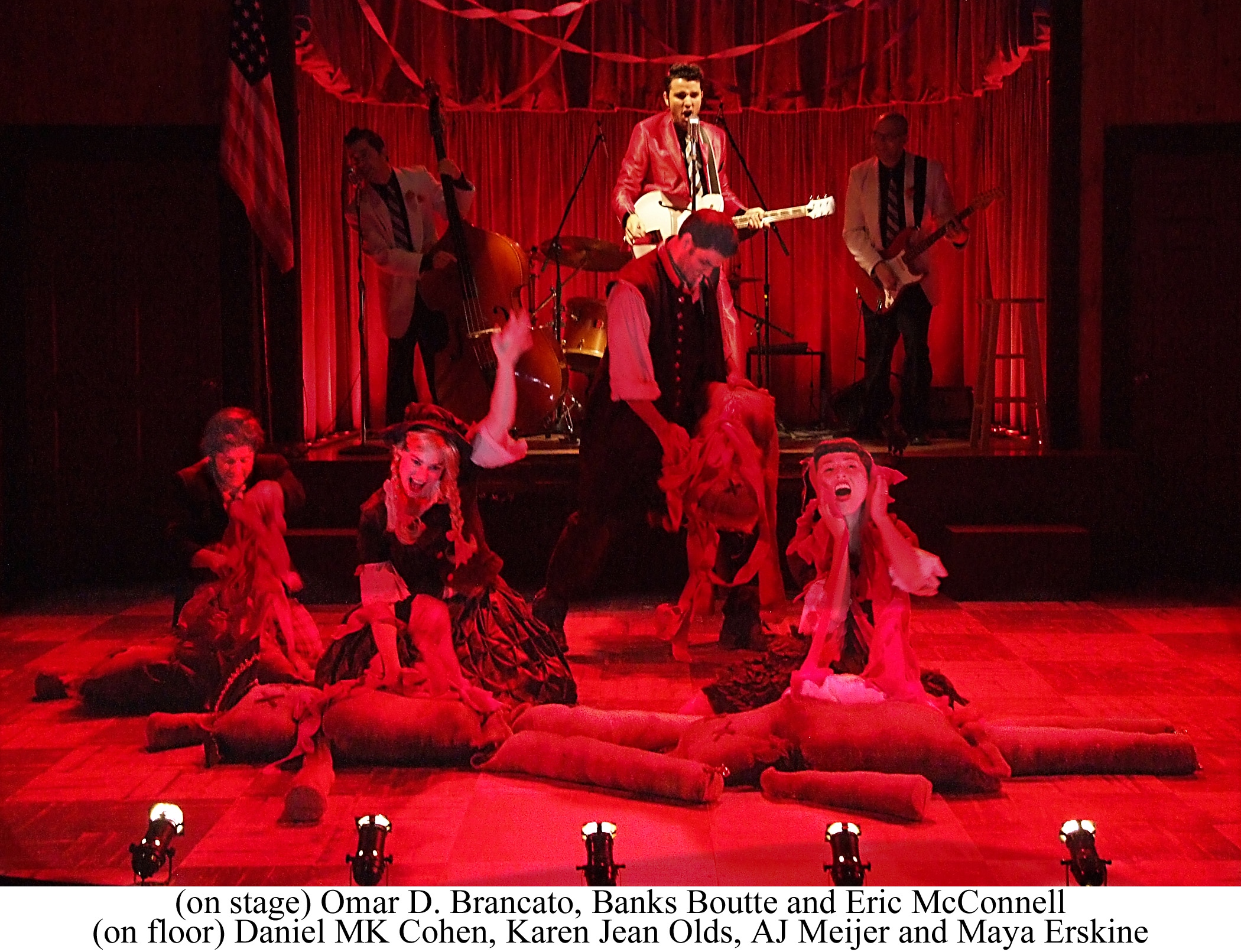
We would have strong red lighting to create an atmosphere of tension and suspense. We would then use a complicite (theatre company) exercise to create a transition: You place a bamboo stick/stick-like object between your index finger and your partners finger. You then travel around the space whilst maintaining eye contact finding interesting ways to move, going up and down, faster and slower. This would create a complex and interesting ritual dance if we pair it with some music in the background. As the ensemble travel round the space I would have Daphne lead Cahle to centre stage and as soon as they hit their mark the ensemble create a tipi around them using the sticks and a blanket is thrown over the top to make it into a tent, completely blocking theme from the audience. We've done this purposefully to create comedy, if the audience can just hear Daphne's lines then their minds will do the rest.

After Daphne's mini-monologue she throws the book out of the tent, this would then be the cue for the stick bearers to disperse and move behind the audience where they would lean their sticks over the seats to create the illusion like the audience are now inside the tent. This in turn solves the problem of visibility and will make the audience feel like they are now apart of the action. We also thought that the men should go up to the balcony to show how they cannot enter the women's place but we can still see their reactions to what's going on.

For the naming song section we were hoping we could have a blackout and then project stars onto the ceiling of Stanley Halls and have the entire ensemble singing twinkle twinkle little star in a round whilst moving around the space as Daphne watches in amazement. This could look really effective as in the darkness the voices will really stand out.


Character Research

In this production I have been cast as "Mau". In my opinion he is a very complex character who is going to be quite a challenge to play however I am looking forward to playing him for the middle section of the play. He has scenes in the dream world, underwater, in the cave of grandfather's to a name a few. When it transitions into my time as Mau he goes through a change from being just a half boy/ half man who isn't quite sure of himself into a strong confident chief of this new titular Nation. In order to Accurately portray this character I need to go through the text and analysis key information about him and then do some of my own research on the word he lives in:

What do people say about Mau?

  • "You have no soul (...) you are between boy-soul and man-soul" - This shows that Mau is not mature yet but he is not a child. He is (in western culture) considered to be adolescent. This is good because he is of the same age as me making him easier to relate to however he has grown up in another societal system where masculinity and coming of age ceremonies exists. In my performance I must portray the importance on masculinity and power in my leadership and attitudes to other males in the Nation.  
  • "Some of them laugh at (...) your trouser man clothes" - We see that Mau is now wearing traditionally western clothes like trousers. This means that he is trying to state his superiority over others through the way he dresses albeit subconsciously. This shows that within the Nation there is some doubt and insubordination, This motivates Mau to try and prove himself and assuage people's fear in his leadership qualities. 
  •  "You're a great Chief" Mau is capable of making good decisions that (even if he doesn't believe in himself) will bring happiness to his people. This means that throughout the piece I must show the evolution of Mau and portray his growth in confidence as a leader and a man.
 What does Mau say about himself?
  • "I'm not ready, I can't carry the burden" He is referring to Pilu volunteering him to be chief. (This is from a section of text where I am not playing Mau however in order to give 3 dimensional performance I must know what thought processes my character has previously had and carry them with me). Mau is reluctant to become and is worried about having such responsibility. This means I must show his insecurities and hesitations when it comes to making decisions. 
  • "I'm Chief. I should watch out for raiders" Mau has now acknowledged his responsibility as Chief and is now actively doing duties. In my performance I must now show the audience that there has been a change in Mau's mentality. It also states in the stage directions; " He now wears Robert's hat and trousers". This shows that he is assimilating the advancements that Daphne has brought with her". I believe now has a slight superiority complex and I must demonstrate this in the way he treats the other Islanders" 
  • "I am strong, The strongest." Mau is defending himself and his own identity. As an actor I need to make a judgement on whether I want to play this line seriously or unsure. At this point in the play I don't believe me is that self assured and is just saying this line to protect his own ego so I shall play slightly unsure but deliver it with strength. 
  • "I am sorry for the angry words I shared with him. I respect and love him as if he were my father. I will take revenge" This is my final line playing Mau so I need to deliver it with passion and emotional depth, Mau has now grown and can recognise his own mistakes. I must show this self-realisation to the audience in the way I phrase the line e.g. putting emphasis on the words "Love" and "Respect". 
Five stages of grief 

On a character analysis I found here: http://www.shmoop.com/nation-pratchett/mau.html, It suggests Mau could be going through the five stages of grief because of the loss of his people. So I did some research on this;


1. Denial: When he returns from the boy island and discovers everyones dead. 
2. Anger: Mau's anger at the God's, Daphne and Ataba.
3. Bargaining: Saving others lives to make up for the loss of his own peoples.

4. Depression: Before Daphne arrives and is isolated. 
5. Acceptance: End of play, Mau becomes a competent chief and leads a new nation.

In conclusion I must use this depth research to shape and characterise Mau as an unsure adolescent and demonstrate his coming of age. I must also successfully show the audience how he copes with the death of his people and how this changes him.  

Sunday, 15 February 2015

First Impressions

On first inspection of the text I was quite excited to be working with such a dynamic and interesting text. It contains many scene was great dramatic potential along with plenty of opportunity for ensemble and physical theatre work. All the characters are very diverse and complex which is appealing to me as an actor. The overall plot is compelling, I don't believe that there is a single dull moment. There a jumps in time and location which means staging it we will need to take into consideration the audience's comprehension of the main action without it getting clouded.

Personally I feel like this may be a huge risk to take. When blocking and choreographing the scenes we may run into several obstacles. For example, a couple of scenes take place underwater. This may is going to be quite a challenge as obviously we can't flood Stanley Hall! We would have to consider the use of props e.g. billowing blue cloths to simulate waves or using blue lighting and utilizing watery sound effects. Another problem we may face will be the casting. They're are a lot of scenes dedicated between the interaction between Mau and Daphne. If we cast a single pair as the main duo then some of the cast may end up with people having tonnes of sections to learn and some people with next to nothing. I propose we split up the main characters based on the character development and specific points in the plot when they've gone through and emotional or physical metamorphosis. For example in one scene Mau says "You look different, Daphne" means she's either change clothes or looks older which would be an optimum time for a change. Also when Mau becomes chief he starts wearing "Trouser Man clothes" this could indicate a costume change as well as a change in actor.

There are numerous amount of songs in the text. I think this could be a good chance to try some choral singing like we did in out little people's day project except we would have a clear rhythm and maybe even accompanying music. Because most of the action takes place on an unspecified polynesian/mediterranean/caribbean so we can take inspiration from any of these cultures. We can do this by using authentic music, or by adopting there traditional costumes or masks. We could even base some of our movement work. For example in most Island cultures they have tribal dances, any sticky or boring transitions can be livened up with tribal style physical theatre dance.

In conclusion "Nation" by Terry Pratchett adapted by Mark Ravenhill is a perfect piece for out final performance, Sure there may be a few kinks we need to iron out but that It'll all be done in the devising process.